
Papuaaround.com – The central government has reaffirmed its commitment to accelerating the economic transformation of Indonesia’s border regions, including Papua, with the goal of turning these areas into new engines of growth. The policy direction emphasizes that state border crossings should not only represent national sovereignty but also serve as catalysts for improving local welfare.
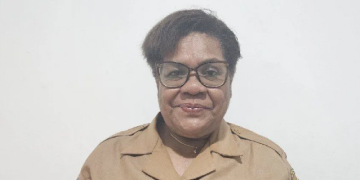
Deputy Minister of Home Affairs Ribka Haluk stated that the initiative aligns with President Prabowo Subianto’s directive to integrate border development with concrete economic acceleration schemes. According to her, this approach is essential to ensure that infrastructure investments in border regions deliver tangible benefits for surrounding communities.
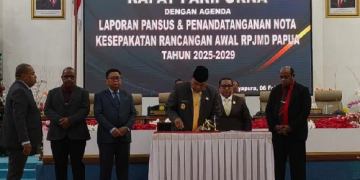
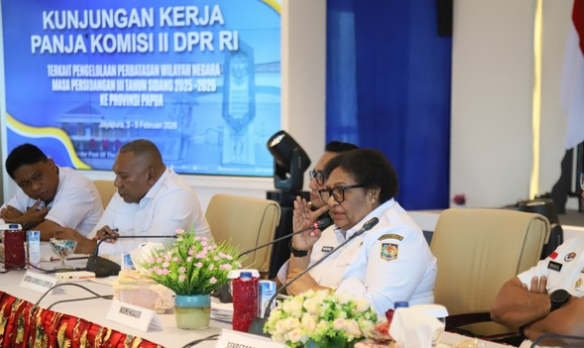
Ribka delivered the statement while accompanying the Working Visit of Commission II of the House of Representatives (DPR RI) to the Papua Governor’s Office in Jayapura. The visit served as a platform to discuss strategic alignment between national policies and regional development priorities, particularly in Papua, which holds special autonomy status.
She explained that the completion and optimization of State Border Posts must be adjusted to regional priority needs. In Papua, border infrastructure development requires careful planning that considers geographic conditions, local economic potential, and long-term sustainability. Therefore, development targets should focus not only on physical structures but also on supporting facilities that stimulate trade, mobility, and investment.
In line with the President’s instructions, three ministries—the Ministry of Home Affairs, the Ministry of Finance, and the Ministry of National Development Planning—have been tasked with coordinating closely with relevant institutions. This coordination aims to strengthen planning, budgeting, and implementation frameworks for border development, both in Papua and other frontier regions.
Ribka emphasized that the working visit was a strategic moment to bridge central government policies with the practical needs of regional administrations. She highlighted that border areas represent the nation’s front porch and require strong regulatory support to unlock their economic potential.
Furthermore, she underlined the importance of collaboration between the Ministry of Home Affairs and the leadership of the DPR to ensure effective oversight and policy support. Through this partnership, the government expects to accelerate inclusive economic growth while maintaining national security and administrative effectiveness in border regions.
During the meeting, Ribka expressed hope that continued collaboration would produce concrete solutions for local governments. She noted that regional administrations need sufficient flexibility to manage and develop border areas in accordance with their unique characteristics. Following the discussion, the delegation planned to conduct on-site inspections of border locations to verify infrastructure readiness and assess supporting facilities.
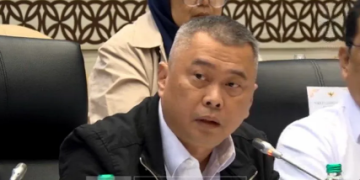
The meeting was attended by the Chair and Vice Chair of Commission II of the DPR RI, along with other commission members. Regional leaders, including the Deputy Governor of Papua and representatives of the provincial leadership coordination forum, were also present, reflecting a shared commitment to advancing border region development through coordinated governance.