


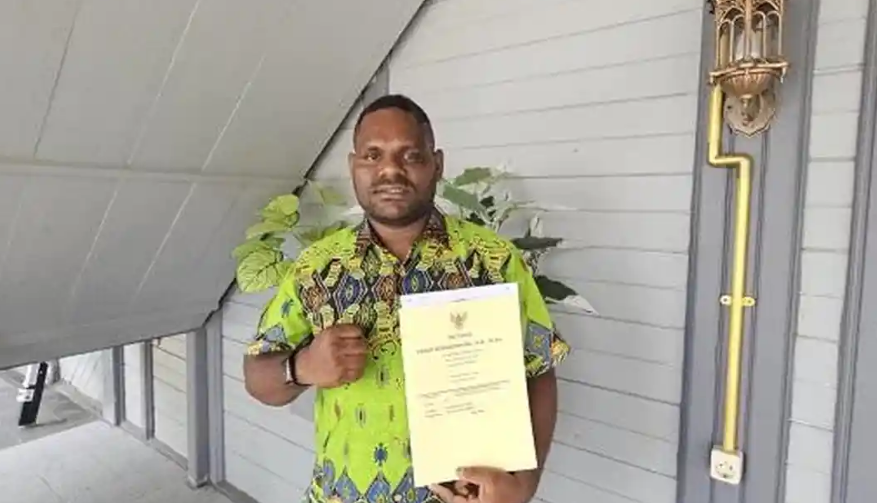
Papuaaround.com – The Central Papua Indigenous Youth Alliance has officially obtained legal recognition after receiving its deed of establishment from the Ministry of Law and Human Rights. The state-issued document, dated November 11, 2025, marks an important milestone for the organization and signals a new phase of institutional legitimacy for indigenous youth movements in Central Papua. With this legal status in place, the alliance now has a clear and formal foundation to carry out its programs and advocacy efforts.
The recognition is widely seen as a step toward strengthening the independence of indigenous youth in safeguarding the rights and interests of customary communities. Legal standing not only provides certainty under the law, but also enables the organization to engage more openly with stakeholders at both regional and national levels. In addition, the formal status is expected to enhance public trust in initiatives driven by indigenous youth.
Roni Loven Duwitau, an administrator of the Central Papua Indigenous Youth Alliance, stated that the organization’s primary focus lies in protecting natural resources while simultaneously developing human resources. According to him, environmental sustainability and human capacity building are closely linked and must be addressed together to ensure the long-term welfare of indigenous communities. For this reason, the alliance positions young people as key actors in preserving customary forests and strengthening community resilience.
In line with this vision, the alliance has outlined several priority programs. One of the main initiatives involves capacity-building training for indigenous youth to monitor the sustainability of customary forests across Central Papua Province. Through this program, participants are expected to gain technical knowledge and field-based skills related to environmental protection, including monitoring methods and reporting mechanisms for potential environmental threats.
Beyond environmental protection, the organization also places strong emphasis on preserving local traditions and cultural values. The alliance plans to facilitate inter-regional cultural exchanges aimed at broadening collective understanding of diverse customs and traditions across Central Papua. These exchanges are designed to help young people learn from one another, strengthen cultural identity, and foster mutual respect among indigenous communities with different backgrounds.
At the same time, the Central Papua Indigenous Youth Alliance is preparing initiatives to equip young people with modern skills relevant to today’s challenges. Scholarship programs and specialized training in information technology and media have been identified as key priorities. Roni explained that indigenous youth need competencies that align with technological developments so they can participate more actively in public discourse and advocate effectively for their communities.
The training curriculum will include computer programming, basic journalism, and legal advocacy skills. With these competencies, indigenous youth are expected to document issues in their regions, communicate community aspirations more clearly, and gain a better understanding of legal frameworks related to indigenous rights. This approach is viewed as essential for strengthening grassroots advocacy and improving the bargaining position of customary communities in development-related discussions.
Furthermore, the alliance aims to consolidate indigenous youth from all eight regencies within Central Papua. This consolidation is considered a strategic effort to ensure that youth movements do not operate in isolation, but instead work together under a shared platform. By uniting young people from various regions, the organization seeks to build a collective force that reflects local diversity while maintaining a common purpose.
From an organizational perspective, the alliance is also preparing for the formal inauguration of its leadership at both provincial and regional levels. This process is expected to take place in the near future and is seen as a crucial step toward operational readiness. Once the organizational structure is fully established, the alliance plans to begin implementing concrete programs that directly address the needs of indigenous communities.
The Central Papua Indigenous Youth Alliance has expressed hope that all relevant stakeholders will provide support for its initiatives. Support from local governments, customary leaders, and the broader community is considered vital to ensuring the sustainability of youth-driven movements. Nevertheless, the organization has emphasized its commitment to remaining independent and prioritizing the interests of indigenous communities above all else.
With legal recognition now secured, the Central Papua Indigenous Youth Alliance enters a new chapter marked by greater responsibility and opportunity. While future challenges are expected, the organization’s leaders believe that a legally recognized platform will enable indigenous youth to participate more meaningfully in protecting their rights, preserving their environment, and shaping the future of Central Papua. Ultimately, the alliance aims to serve as a constructive channel for youth participation amid ongoing social and developmental changes.