


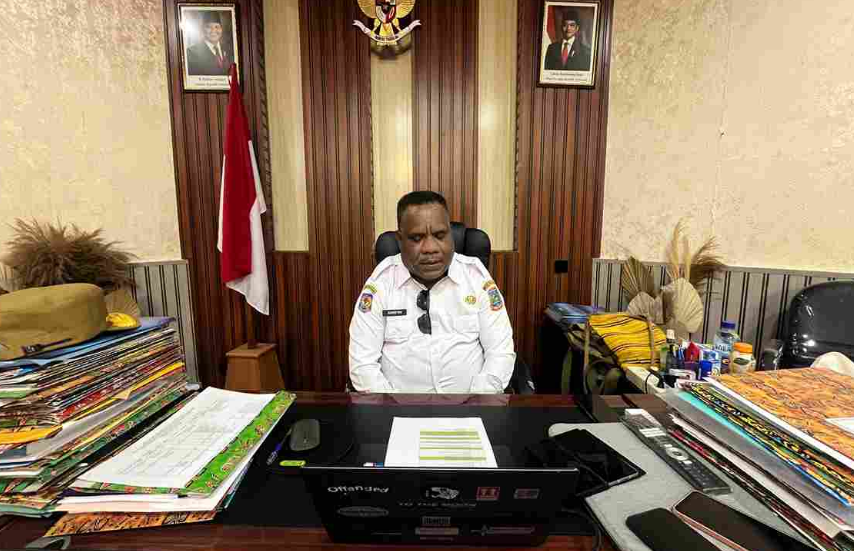
Papuaaround.com – The Central Papua Provincial Government, through the Regional Development Planning, Research, and Innovation Agency (Bapperida), has officially presented a summary of the 2026 Regional Government Work Plan (RKPD). The presentation took place at the Bapperida office on Tuesday, January 7, 2026, marking an important step in outlining the province’s development priorities for the upcoming fiscal year.
Acting Head of Bapperida Central Papua, Eliezer Yogi, emphasized that the 2026 RKPD is designed to ensure alignment between regional development policies and national government programs. According to him, such alignment is essential to address both global and local economic challenges while maintaining sustainable development in Central Papua. He underlined that policy synchronization will help the province respond more effectively to economic uncertainty and structural development gaps.
Eliezer explained that 2026 holds strategic significance for Central Papua. The year represents the full implementation phase of the vision and mission of the definitive Governor and Deputy Governor. This phase is expected to translate long-term political commitments into concrete programs across multiple sectors. Therefore, the RKPD 2026 places strong emphasis on development acceleration, particularly in education, healthcare, economic empowerment, and social welfare.
During the presentation, Eliezer outlined the main priorities of the RKPD 2026 as stipulated in Governor Regulation Number 17 of 2025 concerning the Regional Government Work Plan. The regulation serves as the legal foundation for policy direction and program implementation across provincial institutions. It also ensures consistency between planning documents and budget allocation mechanisms.
In the education sector, the Central Papua Provincial Government plans to strengthen human resource development through a range of targeted initiatives. These include the implementation of a full-day school program, the continuation of free education policies, and the construction of boarding-based schools in strategic areas. In addition, the government aims to expand the Teacher Professional Education Program and develop boarding schools to improve access for students from remote regions. Plans are also underway to establish a provincial university and to ensure equitable distribution of the Free Nutritious Meals program across all districts.
Healthcare development forms another key pillar of the RKPD 2026. The provincial government intends to prioritize the construction of a Provincial General Hospital to enhance referral services. Other planned initiatives include the KoHarusehat program, the development of model community health centers in eight districts, and the preparation of qualified medical personnel. Special attention will be given to increasing the number of indigenous Papuan doctors. Furthermore, healthcare planning includes the construction of maternity clinics and the introduction of advanced services, such as in-vitro fertilization, to broaden access to specialized medical care.
Infrastructure development also features prominently in the 2026 work plan. The government plans to focus on building a centralized provincial government complex to improve administrative efficiency. In addition, road connectivity between districts will be expanded to support mobility and economic integration. Other infrastructure priorities include the provision of clean drinking water, housing development to ensure livable homes, and the expansion of electricity coverage throughout the province. Transportation subsidies, particularly for air transport, are also planned to reduce logistical costs in remote and hard-to-reach areas.
Economic empowerment remains a central objective of the RKPD 2026, with a strong focus on optimizing Central Papua’s leading sectors. Agriculture and livestock development are identified as strategic drivers of local economic growth. To support these sectors, the provincial government plans to provide capital assistance and other forms of support aimed at increasing productivity and strengthening community-based economic activities. These measures are expected to create employment opportunities and improve household incomes, especially in rural areas.
Eliezer stressed that the preparation of the RKPD 2026 is not merely an administrative exercise. Instead, it functions as a strategic instrument to accelerate equitable development across Central Papua. He highlighted that the plan is designed to improve public service quality, enhance community welfare, and uphold the dignity and social standing of Indigenous Papuans.
According to him, the RKPD serves as a guiding framework to ensure that public spending delivers tangible benefits. Every budget allocation, he noted, must generate measurable outcomes that directly impact the lives of Central Papua residents. Through careful planning and coordinated implementation, the provincial government aims to foster inclusive growth and long-term sustainability.
The presentation of the RKPD 2026 summary reflects the Central Papua Provincial Government’s commitment to transparent planning and accountable governance. As the province moves toward full implementation of its development agenda, the RKPD is expected to play a critical role in shaping policies that are responsive to local needs while remaining aligned with national priorities.